Industrial Production Process of a Control Arm
- Share
- Issue Time
- Jan 12,2026
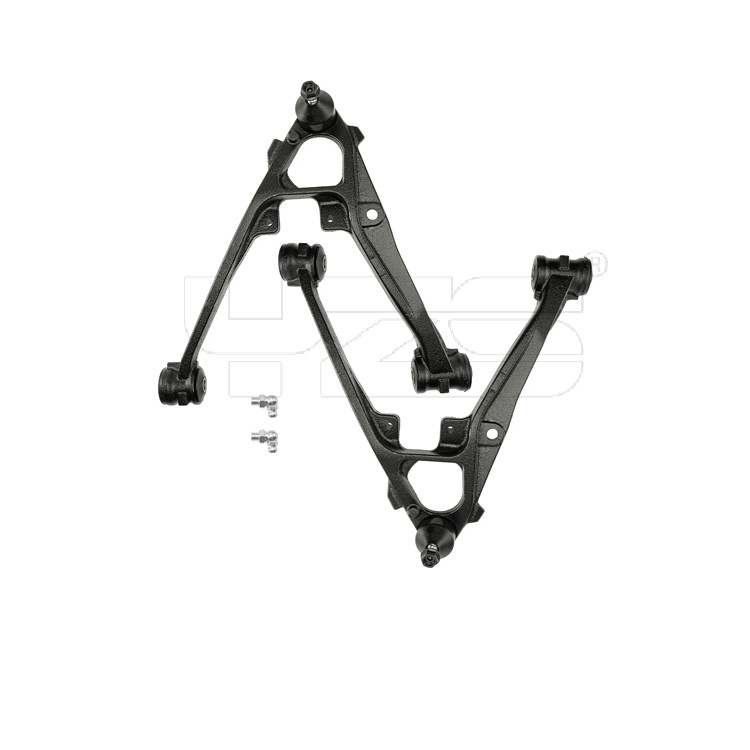
The manufacturing of a control arm is a multi-stage process that transforms raw materials into a high-strength, precision safety component. Here are the key steps involved:
1. Design & Engineering
CAD/CAE Modeling: The process begins with detailed Computer-Aided Design (CAD) modeling and Finite Element Analysis (FEA) simulations to optimize the part for strength, weight, stiffness, and packaging within the vehicle's suspension geometry.
2. Raw Material Preparation
Material Selection: Common materials include:
Forging-grade Steel: For high-strength, forged arms.
Aluminum Alloy Billets: For lightweight, cast or forged performance arms.
Ductile Iron: For cost-effective casting.
Material Cutting: Blanks or billets are cut to the required size and weight for the next forming operation.
3. Primary Forming (The Core Manufacturing Step)
This is the most critical differentiation, with two main methods:
A. Forging (热锻)
Heating: The steel billet is heated to a high temperature (≈1200°C) to increase malleability.
Die Forging: The hot billet is placed in a massive press and forced into a shaped die cavity under extreme pressure (数千吨).
Benefits: Produces parts with superior grain flow continuity, resulting in exceptional strength, toughness, and fatigue resistance. This is the preferred method for high-stress OEM and performance arms.
B. Casting (铸造)
Die Casting/Gravity Casting: Molten aluminum or iron is poured or injected into a precise mold (die).
Benefits: Allows for more complex, hollow shapes to reduce weight. Often used for aluminum control arms. High-pressure die casting can improve density and strength.
4. Secondary Machining (CNC Machining)
The forged or cast "rough" part (called a blank) undergoes precision Computer Numerical Control (CNC) machining.
Critical operations include:
Drilling and reaming the bushing bores and ball joint socket.
Facing mounting surfaces.
Tapping any threaded holes.
This step ensures exact dimensional accuracy for proper fitment and alignment.
5. Heat Treatment
Purpose: To achieve the final required mechanical properties (hardness, strength, ductility).
Typical Process: Quenching and Tempering.
The part is reheated and then rapidly cooled (quenched) to achieve high hardness.
It is then tempered at a lower temperature to reduce brittleness and achieve the optimal balance of strength and toughness.
6. Surface Treatment & Finishing
Shot Peening: A process where small metal spheres are blasted at the part's surface to induce compressive stress, greatly enhancing fatigue life.
Corrosion Protection: Essential for steel parts.
Phosphating/Zinc Plating: Common OE corrosion-resistant coating.
Powder Coating/Painting: Provides both protection and a finished appearance (common on aftermarket parts).
Deburring & Cleaning: Removing any sharp edges or machining debris.
7. Assembly & Quality Integration
Pressing: The rubber or polyurethane bushings and the ball joint assembly are hydraulically pressed into their machined bores. Some high-end arms use bolt-in bushings.
Final Quality Control (QC):
100% Dimensional Inspection: Often using automated Coordinate Measuring Machines (CMM).
Material & Hardness Verification: Spot checks using spectroscopy and durometers.
Functional Tests: Some manufacturers perform load-deflection or dynamic fatigue tests on sample parts from each batch.
8. Packaging & Logistics
Parts are individually packaged to prevent damage during shipping.
Barcoding and labeling for traceability back to the specific production batch, which is crucial for quality recalls.